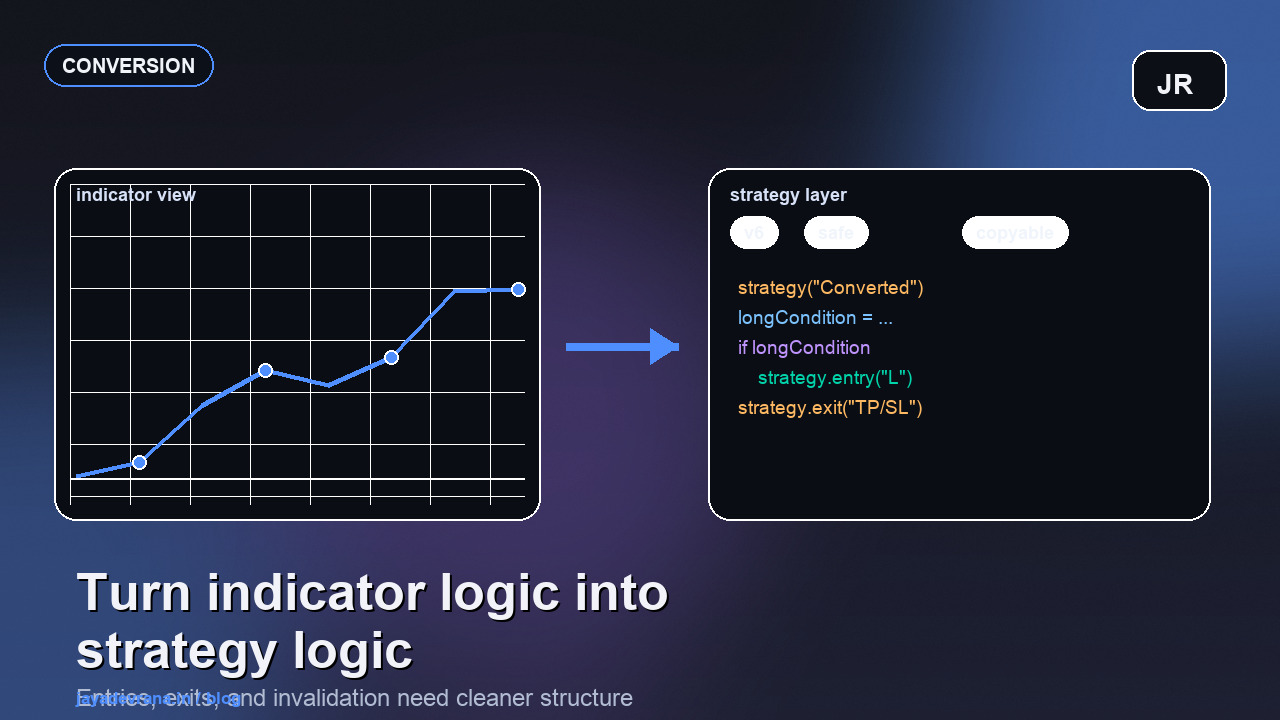
What still matters when the keyword says Pine Script v5
Queries like pine script v5 convert indicator to strategy best practices are still common because traders inherit old scripts, older tutorials, and community snippets. The useful answer in 2026 is not to stay married to v5 wording. The useful answer is to keep the parts that were good engineering habits and update the code path so it is easier to maintain now.
The habits that still matter are boring ones: clear state, confirmed signals where needed, well-named inputs, and explicit exits. Those mattered in v5, and they still matter now.
- separate signal logic from plotting clutter
- name inputs and states clearly enough to revisit later
- test alerts as part of the design instead of after the fact
- treat higher-timeframe logic like a runtime decision, not a cosmetic add-on
Where older best-practice advice falls apart
A lot of older Pine advice assumed that if the script compiled and the chart looked okay, the job was basically done. That is not enough anymore. Traders expect alert behavior, backtest behavior, and visible chart behavior to tell the same story.
The second weak habit is clinging to older code patterns just because the keyword mentioned v5. If you are opening the script today, the cleaner move is usually to port the thinking forward and make the code easier to read in the current language.
- keeping old patterns that nobody can explain anymore
- treating migration as syntax cleanup instead of behavior review
- ignoring repaint risk because the historical chart looked neat
- adding extra filters before the base signal is trustworthy
A safer Pine Script v6 pattern to use now
Even if the search term says v5, the more useful example today is a v6 structure that is easy to audit. That makes the script easier to maintain and easier to convert into strategy or alert work later.
//@version=6
strategy("Indicator to strategy pattern", overlay = true)

fast = ta.ema(close, 21)
slow = ta.ema(close, 55)
longSignal = barstate.isconfirmed and ta.crossover(fast, slow)
flatSignal = barstate.isconfirmed and ta.crossunder(fast, slow)

plot(fast, "Fast EMA", color.new(color.teal, 0), 2)
plot(slow, "Slow EMA", color.new(color.orange, 0), 2)

if longSignal and strategy.position_size <= 0
    strategy.entry("L", strategy.long)

if strategy.position_size > 0
    stopPrice  = strategy.position_avg_price * 0.99
    limitPrice = strategy.position_avg_price * 1.02
    strategy.exit("L exit", "L", stop = stopPrice, limit = limitPrice)

if flatSignal and strategy.position_size > 0
strategy.close("L")Notice what this example does not try to do. It does not chase cleverness. It just gives you a structure that is easier to reason about when you come back to the code a month later.
The review checklist I use before calling the script clean
Before I call a script well-built, I want the signal timing to make sense, the exit logic to be explicit, and the state handling to stay readable. If any one of those is muddy, maintenance becomes the real cost later.
- does the live signal mean the same thing as the historical marker
- is the entry and exit logic separated clearly enough to debug
- would another developer understand the state flow without guessing
- can the script be upgraded again later without untangling chaos first
What to read next
If this topic is part of a bigger TradingView or Pine Script workflow for you, these are the most useful follow-up guides on the site.
- Pine Script strategy() vs indicator()
- Pine Script Backtesting Guide
- Pine Script v5 — Convert Old Code to New Syntax
Send the chart idea, broker, market, and goal on WhatsApp. I can usually tell you quickly whether it needs a custom indicator, a strategy audit, an alert fix, or a broker-ready automation layer.
Related services
Frequently asked questions
Should I still write new scripts in Pine Script v5?
Usually no. Traders still search with v5, but fresh work is normally better done in v6 unless you have a very specific reason to stay older.
Is the hardest part of migration the syntax?
Rarely. The harder part is checking whether the live behavior, alert timing, and higher-timeframe assumptions still make sense after the rewrite.
What is the best first cleanup for old Pine code?
Make the state and signal rules readable first. Once the meaning is clear, version upgrades and strategy logic become much easier.
Can one clean indicator structure later become a strategy?
Yes, but only if the original indicator logic is already explicit enough to define entries, exits, and invalidation without guesswork.
Primary sources and references
I take on Pine Script indicators, TradingView automation layers, strategy audits, and broker-aware execution workflows when the goal is clear and the live behavior actually matters.